

How Machine Shops Keep a Clear View Inside the CNC Enclosure During Wet Machining
Steffen Wilhelm
Short answer
A rotating glass disc keeps a clear view because centrifugal force throws coolant droplets and chips off the glass before they can form a film. Rotoclear builds this principle into two kinds of product: the S3 spinning window, which you look through, and its camera systems. The C2 described in this article puts a camera behind the rotating disc and streams the picture out of the machine. Air blow-off and wipers fight the coolant after it has landed. A spinning disc does not let it settle.
Key Takeaways
- Wet machining fogs, streaks and splashes anything that faces the cut, including the door window and any camera.
- A rotating disc clears its surface continuously, with no wiper stroke and no operator action.
- The S3 is a window; the C2 is a camera. They solve different problems and are specified differently.
- Check purge air, supply voltage and mounting space before you order. These details decide whether the install goes smoothly.
- A clear view supports unattended running. Put a number on it from your own shop's door-opening stops, not from a vendor figure.
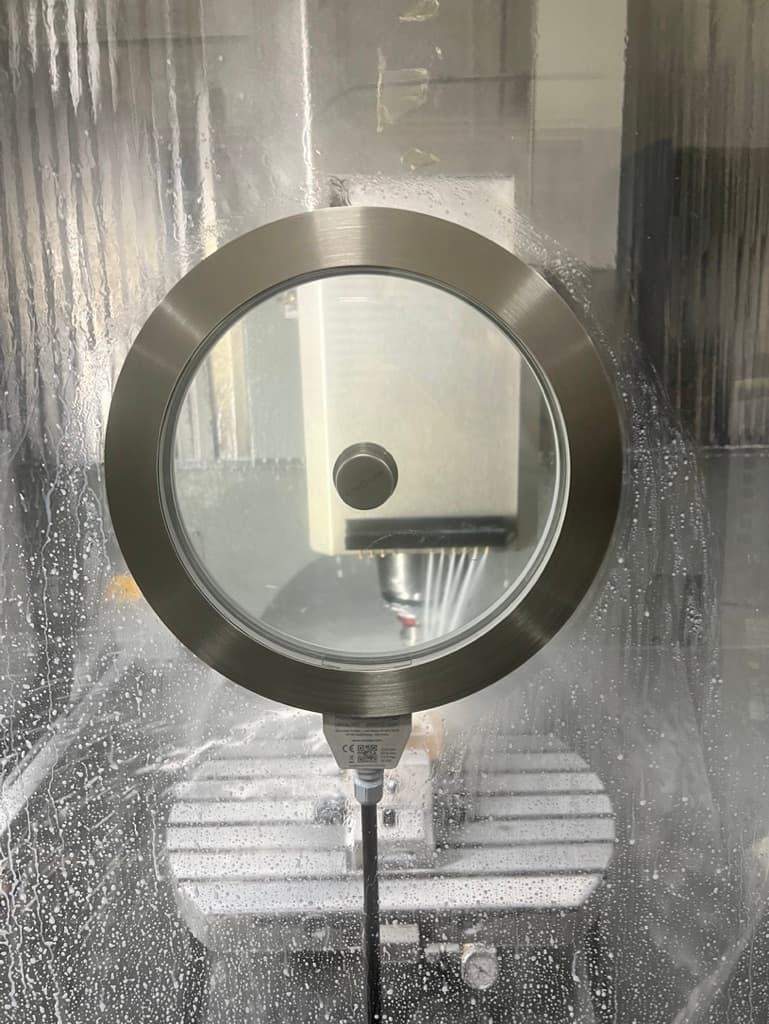
Why the view disappears in wet machining
Flood coolant, high-pressure through-spindle coolant and mist do their job: they cool the cut, flush chips and protect the tool. They also coat everything that faces the cut. The door glass turns to a smear within minutes, and you open the door, or stop the cycle, just to see what the tool is doing.
That matters beyond convenience. If you cannot see the cut, you cannot confirm chip evacuation, spot a loading problem or watch a first-article run without stopping it. If you want someone to check a machine from the office or run a second shift with fewer people on the floor, a window or camera that shows nothing is no help.
The usual fixes, and where they run out
Shops typically try two things first: an air-blast nozzle aimed at the window, or a wiper. Air blow-off is the cheapest and a sensible first step.
The limit is that air and wipers have to remove the coolant after it has landed. With heavy flood coolant, oily films and fine swarf, that is a losing contest. A wiper can also drag fine chips across the glass.
How a rotating disc works
A round glass disc is driven at speed in front of the viewing surface. Coolant that lands on the disc experiences centrifugal force and leaves the surface radially, so the optical path stays clear while the machine is cutting. Rotoclear states that the S3 "employs centrifugal force to create a permanently clear view" and uses a patented, fully sealed drive with a labyrinth seal (Rotoclear S3). The C2 camera system uses the same principle, with the camera behind its own rotating disc.
Window and camera: which does what
Rotoclear S3 spinning window. A rotating glass disc mounted on the machine's door window. The operator looks through it. It gives a clear view where the window used to smear, and needs no camera, network or screen.
Rotoclear C2 camera system. A camera head installed inside the enclosure, behind its own rotating disc, that streams live video out of the machine over HDMI or the network. It is the product for watching the cut without opening the door, with built-in lighting and a control unit that sits in the control cabinet.
Rotoclear's camera line has three systems: C Basic, an entry-level system for real-time monitoring via HDMI; the C2 described here; and C Pro, the high-end system that records the machining process automatically.
The figures below are kept apart on purpose. S3 values do not describe the camera, and camera values do not describe the window.
S3 spinning window specifications
| Item | Value |
|---|---|
| Dimensions | Ø 290 mm x 34 mm (Ø 11.42 in x 1.34 in) |
| Field of view | Ø 232 mm (Ø 9.13 in), minus Ø 40 mm (Ø 1.57 in) in the centre |
| Maximum rotor speed | 2300 rpm |
| Supply voltage | 24 VDC (16-28 V) |
| Power | 24 W, start-up < 60 W |
| Overpressure in connection box | 2-5 mbar (200-500 Pa; 0.03-0.07 psi) |
| Purge air consumption | 1.2 m³/h (0.71 cfm) at 200 Pa (0.03 psi) |
| Air purity | ISO 8573-1:2010 [3:4:3] |
| Operating temperature | 10-60 °C (50-140 °F) |
| Noise | < 65 dB(A) |
| Mounting | Screwed on polycarbonate 6-16 mm (0.24-0.63 in) thick, Ø 256 mm (Ø 10.08 in) hole circle, or bonded to glass |
Source: Rotoclear S3 operating manual (October 2023), specification table.
C2 camera system specifications
According to the manufacturer's product page, the C2 streams live video at up to 4K resolution at 60 frames per second, and the camera head measures 70 mm in diameter by 50 mm (2.76 in by 1.97 in) (Rotoclear C2). The operating manual adds the details that matter for an installation:
| Item | Value |
|---|---|
| Camera head | Ø 70 x 50 mm (Ø 2.76 x 1.97 in), approx. 0.6 kg (1.3 lb) |
| Camera disc speed | 4,000 rpm |
| Video outputs | HDMI; http(s) MJPEG stream; RTSP; still image via http; API available |
| Resolution | 4K at up to 60 fps via HDMI; web stream up to 4K (frame rate depends on network bandwidth); RTSP Full HD/HD |
| Latency | HDMI 0.07 s; Ethernet direct 0.17 s |
| Lighting | Built-in, 1,100 lm, switchable |
| Data cable | 10 m or 20 m (33 ft or 66 ft); up to 60 m (197 ft) with two signal amplifiers |
| Sealing air (camera head) | Required; Ø 6 mm (0.24 in) connection, < 25 l/min (0.88 cfm), 1,150-1,500 mbar absolute (approx. 2.0-7.1 psi gauge at sea level); pressure monitored by a built-in sensor |
| Air purity | ISO 8573-1:2010 [3:4:3] |
| Protection rating | Camera head IP67 with sealing air, spinning window and data cable connected; control unit IP30 (control cabinet) |
| Operating temperature (camera head) | 10-40 °C (50-104 °F) |
| Control unit power | 24 VDC, max. 60 W (with 2 camera heads and 4 signal amplifiers) |
| Control integration | DMG MORI CELOS from version 6; HEIDENHAIN TNC 640, TNC 620, iTNC 530 and others (versions per manual) |
Source: Rotoclear C2 operating manual (April 2024), technical data.
What to check before you buy
Take this list into any conversation with a supplier. Each item names which product the figure belongs to.
- Purge air (S3) and sealing air (C2). Rotoclear requires purge air on the S3 for its seal guarantee, because the slight overpressure keeps coolant and oil out of the unit; under moderate conditions the S3 can run without it if air can flow in through the connection box. Decide which case applies to your machine. If you want the guarantee, confirm shop air at the mounting point with 2-5 mbar (0.03-0.07 psi) in the connection box and a consumption of 1.2 m³/h (0.71 cfm) at 200 Pa (0.03 psi). The C2 camera head is different: it needs sealing air, with a Ø 6 mm (0.24 in) connection, under 25 l/min (0.88 cfm) at 1,150-1,500 mbar absolute (approx. 2.0-7.1 psi gauge at sea level), and a built-in sensor monitors the pressure. Its IP67 rating applies only with sealing air, spinning window and data cable connected.
- Air quality (S3 and C2). Both the S3 purge air and the C2 sealing air must meet ISO 8573-1:2010 class [3:4:3]. Check your compressor's filtration and dryer before the install date, not after.
- Mounting space. The S3 measures Ø 290 mm x 34 mm (Ø 11.42 in x 1.34 in). It is screwed onto polycarbonate between 6 and 16 mm (0.24 and 0.63 in) thick on a Ø 256 mm (Ø 10.08 in) hole circle, or bonded to glass. The C2 camera head is Ø 70 x 50 mm (Ø 2.76 x 1.97 in) and weighs approx. 0.6 kg (1.3 lb), and its control unit (IP30) goes in the control cabinet. Check the clearance around the spindle, tool changer and door travel.
- Power and cabling. S3: 24 VDC (16-28 V), 24 W in operation and under 60 W at start-up. C2: control unit 24 VDC, max. 60 W (with 2 camera heads and 4 signal amplifiers); data cable 10 m or 20 m (33 ft or 66 ft), up to 60 m (197 ft) with two signal amplifiers. Confirm the wiring route through the enclosure does not interfere with the doors or coolant lines.
- Temperature and noise. S3 operating temperature 10-60 °C (50-140 °F); its own noise is below 65 dB(A). C2 camera head operating temperature 10-40 °C (50-104 °F).
- Video path and network (C2). Decide how you will watch: HDMI to a monitor at the machine (0.07 s latency), or the http(s) MJPEG or RTSP stream over the network (0.17 s on a direct Ethernet connection; web stream frame rate depends on bandwidth, RTSP in Full HD/HD). For network viewing, involve whoever manages your shop network before purchase, decide who may view the stream, and keep the camera on its own network segment.
- Control integration (C2). The C2 integrates with DMG MORI CELOS from version 6 and with HEIDENHAIN TNC 640, TNC 620, iTNC 530 and others; check the supported versions in the manual against your control.
- Rotor maintenance (S3). The S3 rotor uses NdFeB magnets, so fine chips can stick to the inside of the rotor over time. When you service the unit, clean the rotor with a holding magnet before reinstalling it. Plan this as a routine maintenance step.
From the field: how All CNC installs it
All CNC installs the Rotoclear S3 and the Rotoclear C Pro camera system on-site at the customer's shop. Before anything is mounted, we decide together with the customer where the window or the camera head goes, so the operator gets the best possible view of the cut for the work the machine actually runs.
The C Pro records continuously in the background (Rotoclear's Visual Backup). On our installs we set it up to keep four weeks of recordings on 4 TB of storage, so a crash or a scrapped part can be reviewed days later.
On a DMU 40 Plus, for example, we bonded an S3 directly onto the machine's existing window, following Rotoclear's process: template, primer, flash-off, flange, then the S3.
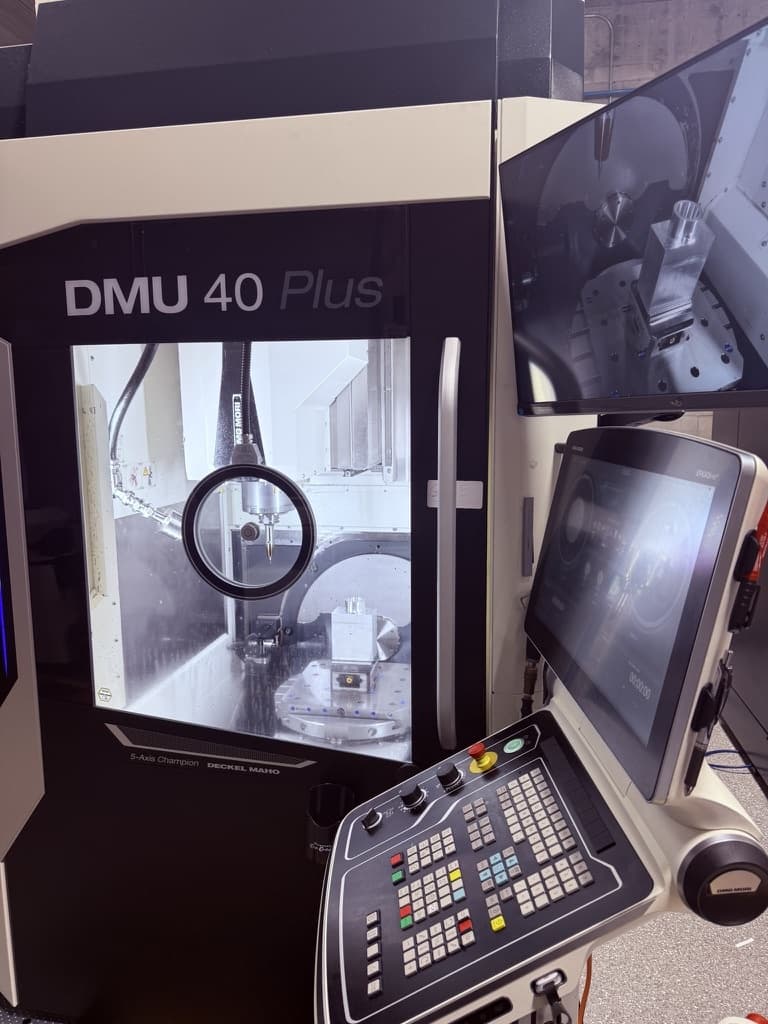
What a clear view is worth
That depends on your work, and no vendor figure will tell you. For a quick internal estimate, count the stops per week where someone opens a door only to look. Multiply by the minutes each stop costs and your machine's hourly rate. That gives you a number from your own shop, which beats any published case.
FAQ
Does a rotating disc need coolant to be off? No. Wet machining is the use case it is designed for. On All CNC's installs the units run with flood coolant and flying chips in the enclosure.
Can I fit this to an older machine? Often, if you have mounting space, 24 V power and an air line (sealing air is required for the C2 camera head; purge air for the S3 seal guarantee). A retrofit kit exists for third-party units, including replacing an existing spinning window.
Which one do I need, S3 or C2? If the problem is that you cannot see through the door, the S3. If you want to watch the cut on a screen outside the machine, the C2.
All CNC installs Rotoclear on-site nationwide. Configure your system at allcncs.com/en/rotoclear/configurator.
Sources
- Rotoclear S3 operating manual (October 2023), specification table
- Rotoclear S3 product page
- Rotoclear C2 product page
- Rotoclear C2 operating manual (April 2024), technical data